


How To Choose A Modification
#1
 08-25-2005, 08:57 AM


 How To Choose A Modification
How to Choose A Modification
--------------------------------------------------------------------------------
I've noticed how often newbies (and not so newbies confused by the multi-voiced claims of the marketplace) seek help in determining which mod to start with, add on, or benefit from. Trying to find a logical method of quantifying in some way all these diverse mods is difficult, but I think I've come up with a method that will often work.
The Augus issue of MMFF features an column by Richard Holdener that contains some simple math one can use to compute the effect of a given modification on a given car. The logic goes:
1. Compute the number of g's (gravities) you car produced in current form. The example he used was a 5 speed car with 400 lb feet of torque, a 3.27:1 final drive and a 2.95:1 first gear ratio. Drivetrain efficiency was set at 87% (average for a 5 speed - automatics would be lower) to compensate for lossed in the clutch, transmission and rear, and the tires had a rolling radius of 1.1 foot (racing slick, but close to that of many 315 drag radials as well). The car in the example weighed 3000 pounds. Here is the formula:
2.95 x 3.27 x 0.87 x 400 / (divided by) 1.1 = 3,356.98/1.1 = 3051.80 pounds of thrust. Next divide the thrust by the weight of the car:
3051.80 / 3000 = 1.017 g's of acceleration.
Changes to any of the variables will rais or lower the acceleration number, ie, add 100 lb/ft of torque with a nitrous kit, and you get 1.27 g's.
Change to 4.10 gears, and you get 1.278 g's.
Reduce the weight of the car by 600 lbs, and you get 1.271 g's.
Obviously you can also dollarize the equation, assigning the cost of the modification to the g's, ie:
Nitrous kit costs $1200, you gain .25 g's, the cost is $480 per .1 g gained.
Gears cost $600, you gain .25 g's, the cost is $240 per .1 g gained.
As you can see, the better investment purely from this standpoint are the Gears - more "bang for the buck".
The article contains many caveats regarding things like aerodynamic drag not being factored into the equation - and this is true. But this forumula is at least invaluable in prioritizing the various modifications in at east a quasi-scientific manner. Just plug in your particular variables, and you have a number that means something.
If you can find it, seek out the article and read it (he has a similar write-up in the July issue regarding lateral acceleration, ie, handling and braking, that has similar potential in determining which handling modifications to do first.
I think aerodynamic loads get discussed next month. I for one am all ears.
tripleblack
__________________
tripleblack
2002 GT Convertible - Cervini ram air & bumper - Accufab 75mm - C&L plenum - MAC CAI - Bassani X pipe - Comp Cams - Diablo Predator tune - Steeda G-Trac Stage 1 - PIAA driving lights - Steeda Tri-Ax - Steeda strut tower brace - Steeda C/C plates - Steeda Sport Springs - Optima Red Top battery - Assorted billet and bling (just a little) and custom paint - 18x9 & 18x10 polished bullits - Coming soon to this stang...
Kenne Bell 1.7 sc kit
--------------------------------------------------------------------------------
I've noticed how often newbies (and not so newbies confused by the multi-voiced claims of the marketplace) seek help in determining which mod to start with, add on, or benefit from. Trying to find a logical method of quantifying in some way all these diverse mods is difficult, but I think I've come up with a method that will often work.
The Augus issue of MMFF features an column by Richard Holdener that contains some simple math one can use to compute the effect of a given modification on a given car. The logic goes:
1. Compute the number of g's (gravities) you car produced in current form. The example he used was a 5 speed car with 400 lb feet of torque, a 3.27:1 final drive and a 2.95:1 first gear ratio. Drivetrain efficiency was set at 87% (average for a 5 speed - automatics would be lower) to compensate for lossed in the clutch, transmission and rear, and the tires had a rolling radius of 1.1 foot (racing slick, but close to that of many 315 drag radials as well). The car in the example weighed 3000 pounds. Here is the formula:
2.95 x 3.27 x 0.87 x 400 / (divided by) 1.1 = 3,356.98/1.1 = 3051.80 pounds of thrust. Next divide the thrust by the weight of the car:
3051.80 / 3000 = 1.017 g's of acceleration.
Changes to any of the variables will rais or lower the acceleration number, ie, add 100 lb/ft of torque with a nitrous kit, and you get 1.27 g's.
Change to 4.10 gears, and you get 1.278 g's.
Reduce the weight of the car by 600 lbs, and you get 1.271 g's.
Obviously you can also dollarize the equation, assigning the cost of the modification to the g's, ie:
Nitrous kit costs $1200, you gain .25 g's, the cost is $480 per .1 g gained.
Gears cost $600, you gain .25 g's, the cost is $240 per .1 g gained.
As you can see, the better investment purely from this standpoint are the Gears - more "bang for the buck".
The article contains many caveats regarding things like aerodynamic drag not being factored into the equation - and this is true. But this forumula is at least invaluable in prioritizing the various modifications in at east a quasi-scientific manner. Just plug in your particular variables, and you have a number that means something.
If you can find it, seek out the article and read it (he has a similar write-up in the July issue regarding lateral acceleration, ie, handling and braking, that has similar potential in determining which handling modifications to do first.
I think aerodynamic loads get discussed next month. I for one am all ears.
tripleblack
__________________
tripleblack
2002 GT Convertible - Cervini ram air & bumper - Accufab 75mm - C&L plenum - MAC CAI - Bassani X pipe - Comp Cams - Diablo Predator tune - Steeda G-Trac Stage 1 - PIAA driving lights - Steeda Tri-Ax - Steeda strut tower brace - Steeda C/C plates - Steeda Sport Springs - Optima Red Top battery - Assorted billet and bling (just a little) and custom paint - 18x9 & 18x10 polished bullits - Coming soon to this stang...
Kenne Bell 1.7 sc kit


#5
08-25-2005, 07:10 PM
Sorry for the typos
Sorry 'bout the typos. Should have proofed it.
Also, hope everyone noticed that weight has a slot in the equation. A modification that increases power AND weight at the same time has a multiplier effect, ie, an aluminum drive shaft might increase power to the rear wheels and shave weight at the same time. Modifications like aluminum heads (I know, only for older cars, but still, the idea is that this formula works for all cars) would be a double hit, too.
Just a reminder - if you use the formula to analyze a future mod, check to see if the mod will save (or add) weight. In fact, I noticed in his nitrous example that he didn't add the 20 pounds or so that the system would weigh.
tripleblack
Also, hope everyone noticed that weight has a slot in the equation. A modification that increases power AND weight at the same time has a multiplier effect, ie, an aluminum drive shaft might increase power to the rear wheels and shave weight at the same time. Modifications like aluminum heads (I know, only for older cars, but still, the idea is that this formula works for all cars) would be a double hit, too.
Just a reminder - if you use the formula to analyze a future mod, check to see if the mod will save (or add) weight. In fact, I noticed in his nitrous example that he didn't add the 20 pounds or so that the system would weigh.
tripleblack
#6
08-25-2005, 10:31 PM

Underneath all that technical crap is the same adage that has been around for years.....power vs weight...plain and simple. Its being over examined. Perfect example is an O/R X pipe compared to a stock H. 99% of your gain is because you just dropped 30lbs, not because you picked up 10rwhp. Or adversely those C&L freakin caveman club inlet tubes....those things weigh a ton compared to the stock plastic units..so any actual hp gains you get from them is instantly negated because of the extra weight. Its not rocket science, just common sense. Keep these 3 figures in mind when buying parts.
10rwhp= .10(one tenth of one second at the track)
10lbs sprung weight=.010(one hundredth of one second at the track)
10lbs unsprung weight= .10
These are not end all be all numbers but they are pretty damn close.
Adam
10rwhp= .10(one tenth of one second at the track)
10lbs sprung weight=.010(one hundredth of one second at the track)
10lbs unsprung weight= .10
These are not end all be all numbers but they are pretty damn close.
Adam
#7
08-26-2005, 07:35 AM
Sure
Common misconception. If you drop 30#, your gain (using the example above) would be:
3051.8 / 2970 = 1.03 g
Whereas the 10hp gain would be:
3128 / 3000 = 1.04 g (slightly more advantage from 10 hp vs 30# wt. reduction)
Since you get both with the hypothetical change, the numbers would be:
3128.1 / 2970 = 1.05 g
Given a choice between shaving 30# or adding 10 hp, add the 10 hp. You're better off, particularly since more hp will help to overcome the increased aero load generated by more acceleration, etc.
As for the C&L intakes, they are definitely heavy suckers. Based on shipping weights, they look to weigh 9 pounds more than the plastic oe. C&L claims they add 7hp to an 02-03 GT.
Using our example mule, the numbers would be:
3128.1 / 3000 = 1.04 before the C&L
3181.5 / 3009 = 1.06 after the C&L - a clear but not earthshaking gain.
for the 7hp gain from the C&L to be negated to parity, it would have to weigh about 50 pounds more than the oe plastic intake.
However, if the question is whether the 7hp gain (and 9 # weight disadvantage) is worth the $100 it would cost - probably not a good modification for most people. Cost to benefit ratio is rather low. Just good common sense.
tripleblack
3051.8 / 2970 = 1.03 g
Whereas the 10hp gain would be:
3128 / 3000 = 1.04 g (slightly more advantage from 10 hp vs 30# wt. reduction)
Since you get both with the hypothetical change, the numbers would be:
3128.1 / 2970 = 1.05 g
Given a choice between shaving 30# or adding 10 hp, add the 10 hp. You're better off, particularly since more hp will help to overcome the increased aero load generated by more acceleration, etc.
As for the C&L intakes, they are definitely heavy suckers. Based on shipping weights, they look to weigh 9 pounds more than the plastic oe. C&L claims they add 7hp to an 02-03 GT.
Using our example mule, the numbers would be:
3128.1 / 3000 = 1.04 before the C&L
3181.5 / 3009 = 1.06 after the C&L - a clear but not earthshaking gain.
for the 7hp gain from the C&L to be negated to parity, it would have to weigh about 50 pounds more than the oe plastic intake.
However, if the question is whether the 7hp gain (and 9 # weight disadvantage) is worth the $100 it would cost - probably not a good modification for most people. Cost to benefit ratio is rather low. Just good common sense.
tripleblack
Originally Posted by ModMotorRacer
Underneath all that technical crap is the same adage that has been around for years.....power vs weight...plain and simple. Its being over examined. Perfect example is an O/R X pipe compared to a stock H. 99% of your gain is because you just dropped 30lbs, not because you picked up 10rwhp. Or adversely those C&L freakin caveman club inlet tubes....those things weigh a ton compared to the stock plastic units..so any actual hp gains you get from them is instantly negated because of the extra weight. Its not rocket science, just common sense. Keep these 3 figures in mind when buying parts.
10rwhp= .10(one tenth of one second at the track)
10lbs sprung weight=.010(one hundredth of one second at the track)
10lbs unsprung weight= .10
These are not end all be all numbers but they are pretty damn close.
Adam
10rwhp= .10(one tenth of one second at the track)
10lbs sprung weight=.010(one hundredth of one second at the track)
10lbs unsprung weight= .10
These are not end all be all numbers but they are pretty damn close.
Adam

#9
11-11-2005, 12:39 PM

i would think measuring performance with a first gear acceleration number would not be that beneficial. there is a lot of thrust in first gear, but when your in third you really start to notice that all that hp isnt doing anything in a heavier car. i'd rather stick to power to wieght ratio numbers. less math too. but that is just my opinion.
#10
12-14-2005, 09:32 AM
Originally Posted by tripleblack
Common misconception. If you drop 30#, your gain (using the example above) would be:
3051.8 / 2970 = 1.03 g
Whereas the 10hp gain would be:
3128 / 3000 = 1.04 g (slightly more advantage from 10 hp vs 30# wt. reduction)
Since you get both with the hypothetical change, the numbers would be:
3128.1 / 2970 = 1.05 g
Given a choice between shaving 30# or adding 10 hp, add the 10 hp. You're better off, particularly since more hp will help to overcome the increased aero load generated by more acceleration, etc.
As for the C&L intakes, they are definitely heavy suckers. Based on shipping weights, they look to weigh 9 pounds more than the plastic oe. C&L claims they add 7hp to an 02-03 GT.
Using our example mule, the numbers would be:
3128.1 / 3000 = 1.04 before the C&L
3181.5 / 3009 = 1.06 after the C&L - a clear but not earthshaking gain.
for the 7hp gain from the C&L to be negated to parity, it would have to weigh about 50 pounds more than the oe plastic intake.
However, if the question is whether the 7hp gain (and 9 # weight disadvantage) is worth the $100 it would cost - probably not a good modification for most people. Cost to benefit ratio is rather low. Just good common sense.
tripleblack
3051.8 / 2970 = 1.03 g
Whereas the 10hp gain would be:
3128 / 3000 = 1.04 g (slightly more advantage from 10 hp vs 30# wt. reduction)
Since you get both with the hypothetical change, the numbers would be:
3128.1 / 2970 = 1.05 g
Given a choice between shaving 30# or adding 10 hp, add the 10 hp. You're better off, particularly since more hp will help to overcome the increased aero load generated by more acceleration, etc.
As for the C&L intakes, they are definitely heavy suckers. Based on shipping weights, they look to weigh 9 pounds more than the plastic oe. C&L claims they add 7hp to an 02-03 GT.
Using our example mule, the numbers would be:
3128.1 / 3000 = 1.04 before the C&L
3181.5 / 3009 = 1.06 after the C&L - a clear but not earthshaking gain.
for the 7hp gain from the C&L to be negated to parity, it would have to weigh about 50 pounds more than the oe plastic intake.
However, if the question is whether the 7hp gain (and 9 # weight disadvantage) is worth the $100 it would cost - probably not a good modification for most people. Cost to benefit ratio is rather low. Just good common sense.
tripleblack
 More power with more weight breaks parts....period.
Adam
#11
12-15-2005, 08:11 AM
 No problem
The whole idea of the post was not to argue any particular method of going faster is "superior", just that when choosing between alternatives (usually in a dollar-driven, cost-is-an-object real world) it helps to have a logical process to help you vs just anecdotal evidence.
The example you sited was a very good one - and one that many folks will be choosing between right about now.
As for "overanalyzing", the math is 8th grade level at most. Its simple to use, and takes little time.
As for decreasing your weight benefiting your ets much more than an increase in power, without quantifying either side of the equation, this is impossible to prove. By this philosophy a gain of 150hp would be less advantageous than a loss of 3 pounds in weight.
Experience is supremely important. But there is a place for science as well.
As for education, I just test well .
tripleblack
The example you sited was a very good one - and one that many folks will be choosing between right about now.
As for "overanalyzing", the math is 8th grade level at most. Its simple to use, and takes little time.
As for decreasing your weight benefiting your ets much more than an increase in power, without quantifying either side of the equation, this is impossible to prove. By this philosophy a gain of 150hp would be less advantageous than a loss of 3 pounds in weight.
Experience is supremely important. But there is a place for science as well.
As for education, I just test well .
tripleblack
Originally Posted by ModMotorRacer
Sorry but I don't have the education that you do, but I do have the real world experience from actual testing. None of those numbers are always true. Like I said, overanalyzing is confusing to many. I know what works and what doesn't, and decreasing your weight will benefit your ET's much more than an increase in power. Both are ideal. The "aero" affects you speak of are not going to make or break anyone at the 12-13sec levels of racing. Not to mention, the lighter weight/rotating assembly will be much easier on parts. Thats learned, and not from a book. More power with more weight breaks parts....period.
Adam
More power with more weight breaks parts....period.Adam
#12
12-15-2005, 11:08 AM
All I can tell you is that I am a bracket racer, so small increases in power and small increases/decreases in weight sometimes make a huge difference and sometimes don't. There are so many other factors that your "8th grade" math isn't taking into consideration. I think that its great that you have formulas worked out, but unfortunately there is much more to it than that. I don't use hp numbers to calculate anything which is the biggest mistake you can make. Especially manufacturer provided numbers. Weather, track conditions, track temp, wind, etc etc etc, are the only real numbers that matter. You don't race a computer or a calculater.
#14
12-15-2005, 02:52 PM
Bracket
It would be fun to bench race alternatives in a race-oriented thread - its just that the idea here was simply to lay out an alternative method of prioritizing modification decisions. The fact that it doesn't help a racer (who if he's half serious is far beyond deciding between spending his allowance on either a CAI or a set of gears) is not surprising. Good luck to you in your efforts - I hope next year is your greatest ever.
tripleblack
tripleblack
Originally Posted by ModMotorRacer
All I can tell you is that I am a bracket racer, so small increases in power and small increases/decreases in weight sometimes make a huge difference and sometimes don't. There are so many other factors that your "8th grade" math isn't taking into consideration. I think that its great that you have formulas worked out, but unfortunately there is much more to it than that. I don't use hp numbers to calculate anything which is the biggest mistake you can make. Especially manufacturer provided numbers. Weather, track conditions, track temp, wind, etc etc etc, are the only real numbers that matter. You don't race a computer or a calculater.
#15
12-15-2005, 03:15 PM
About the same
In the example, the results were about the same for the gears/nitrous equation, although including the 20# weight of the nitrous rig would tip the scales ever so slightly in favor of the gears... All dependent on the real world power gained, of course. Nitrous results are influenced by nozzle size, fuel pressure/delivery and lots of good tuning to extract the power. A 50 shot would not equal gears, whereas a 125 shot might be a shade more for your money. Gears are pretty simple, so the equation is pretty stable when looking at them, including seeing what happens when you plug in 2nd gear, 3rd, etc., depending on which is more important to your application. A better overall average could be achieved by running the comparison in all the gears you cover in a typical quarter mile run, if that is the place you plan to orient your car towards... Add them together and weight them as you like, depending on the amount of time you spend in each gear. This is also a way to evaluate strategy - what acceleration would I gain by spending more time in a given gear, etc?
Of course, as has been pointed out, hp that doesn't reach the ground (traction limit) doesn't do you any good. If you raise your power levels beyond your car's ability to use the power, without increasing your chances of hooking up, you are entering the realm of "dyno racing", which like the older "bench racing", can be fun, but proves little.
Also, gears are always "on", and never suffer from an empty bottle.
tripleblack
Of course, as has been pointed out, hp that doesn't reach the ground (traction limit) doesn't do you any good. If you raise your power levels beyond your car's ability to use the power, without increasing your chances of hooking up, you are entering the realm of "dyno racing", which like the older "bench racing", can be fun, but proves little.
Also, gears are always "on", and never suffer from an empty bottle.
tripleblack
Originally Posted by slappy
So when lookin at the G's, Does that mean that 4:10's have the same performance gain as nitrous?
Can anyone confirm this by when that have felt when upgrading one or the other?
Can anyone confirm this by when that have felt when upgrading one or the other?
#16
12-15-2005, 04:22 PM
Originally Posted by tripleblack
It would be fun to bench race alternatives in a race-oriented thread - its just that the idea here was simply to lay out an alternative method of prioritizing modification decisions. The fact that it doesn't help a racer (who if he's half serious is far beyond deciding between spending his allowance on either a CAI or a set of gears) is not surprising. Good luck to you in your efforts - I hope next year is your greatest ever.
tripleblack
tripleblack
Yes, they could be helpful to a performance oriented guy though.
#17
12-16-2005, 05:37 AM
Power to gears
Just noticed this post. The first gear numbers are a variable - the formula works for 2nd, 3rd, 6th... use any gear ratios you like, it still computes.
The whole idea of including gearing as a variable in the formula allows you to examine the effect of changes other than weight and horsepower. Without this, how to judge the potential effect of taller gears or swapping to a 6 speed or aod?
Weight/horsepower is an important ratio, as is weight/torque. Being able to compare a series of gear changes that don't alter either weight or torque but DO alter acceleration, et, etc is also good to know.
tripleblack
The whole idea of including gearing as a variable in the formula allows you to examine the effect of changes other than weight and horsepower. Without this, how to judge the potential effect of taller gears or swapping to a 6 speed or aod?
Weight/horsepower is an important ratio, as is weight/torque. Being able to compare a series of gear changes that don't alter either weight or torque but DO alter acceleration, et, etc is also good to know.
tripleblack
Originally Posted by stangb16a
i would think measuring performance with a first gear acceleration number would not be that beneficial. there is a lot of thrust in first gear, but when your in third you really start to notice that all that hp isnt doing anything in a heavier car. i'd rather stick to power to wieght ratio numbers. less math too. but that is just my opinion.
#18
12-16-2005, 02:10 PM
Altering gearing does affect weight though, and reciprocating weight too. A numerically higher gear has a thicker ring gear and a thicker pinion gear so it weighs more, and is more of a drag on the drivetrain even though it produces a higher torque multipication. Same with adding a 6 speed tranny , you have all the gearsets for the one more gear making it heavier. Like a C4 compared to a 4R70W, the C4 weighs less but is it really an advantage if I have a custom gearset (steep) 1-3 and a highway OD gear in the 4R70W even if the tranny weighs more? Like i said, its hard to just throw a blanket over everything and call it covered.
Adam
Adam
#19
12-16-2005, 02:44 PM
Gear wt
Absolutely. Some pretty fun fireworks occur when you have a set of gears lightened, too. Its almost scarey the amount of noise and sparks generated in the process. Once one gets serious about a build, weighing various decisions (and parts) becomes an integral element in the plan. Trimming unneeded components from rear differentials and lightening gear sets can subtract considerable weight. Lightweight brake gear and wheels are good places to shave weight, as are losing luxury items like heavy speakers and stereos, etc, etc. The comparison(s) should include the various weights, and any other variables you can predict.
I know I'm overly meticulous about such things as the weights of the various components in a build-up (I keep an old set of scales in my garage - no kidding), but I also know that not every modification will be a success. Adding a little power and a lot of weight is a good way to lose ground. As I mentioned in the original analysis of nitrous vs gears, both changes also should reflect changes in weight. The full nitrous bottle, hoses, solenoids, switches, etc. is not weightless, nor are the higher gears usually the same weight as the oe items (lightening gears is a specialized machining job best left to experts - gears are damn tough, and easily destroyed in the hands of an amateur machinist - there's a good road-racing write-up re. this in a mmff mag from about a year ago).
If anyone wants to compare something and are having trouble with the math, post as much info as you have about the items you're trying to compare and I'll see what I can do with the math side (and I bet Adam can tell you whether or not it will work at all in the real world). The more data you can supply, the better (weight of components, gear ratios, anticipated hp and torque change, etc.). If you're just "estimating" something, thats ok, just keep in mind that the wilder the estimate, the more useless the outcome is likely to be.
tripleblack
I know I'm overly meticulous about such things as the weights of the various components in a build-up (I keep an old set of scales in my garage - no kidding), but I also know that not every modification will be a success. Adding a little power and a lot of weight is a good way to lose ground. As I mentioned in the original analysis of nitrous vs gears, both changes also should reflect changes in weight. The full nitrous bottle, hoses, solenoids, switches, etc. is not weightless, nor are the higher gears usually the same weight as the oe items (lightening gears is a specialized machining job best left to experts - gears are damn tough, and easily destroyed in the hands of an amateur machinist - there's a good road-racing write-up re. this in a mmff mag from about a year ago).
If anyone wants to compare something and are having trouble with the math, post as much info as you have about the items you're trying to compare and I'll see what I can do with the math side (and I bet Adam can tell you whether or not it will work at all in the real world). The more data you can supply, the better (weight of components, gear ratios, anticipated hp and torque change, etc.). If you're just "estimating" something, thats ok, just keep in mind that the wilder the estimate, the more useless the outcome is likely to be.
tripleblack
Originally Posted by ModMotorRacer
Altering gearing does affect weight though, and reciprocating weight too. A numerically higher gear has a thicker ring gear and a thicker pinion gear so it weighs more, and is more of a drag on the drivetrain even though it produces a higher torque multipication. Same with adding a 6 speed tranny , you have all the gearsets for the one more gear making it heavier. Like a C4 compared to a 4R70W, the C4 weighs less but is it really an advantage if I have a custom gearset (steep) 1-3 and a highway OD gear in the 4R70W even if the tranny weighs more? Like i said, its hard to just throw a blanket over everything and call it covered.
Adam
Adam
#20
12-17-2005, 08:00 PM
"If you're just "estimating" something, thats ok, just keep in mind that the wilder the estimate, the more useless the outcome is likely to be."
AMEN TO THAT
AMEN TO THAT
#21
07-27-2006, 10:30 AM

Man. Things sure have changed. Back in my day you just took out what you could to lose weight, increased Cubes where possible, got as much fuel in as you could and tried to make it breathe easy. Now a guy darn near needs to know calculus to figure out what to do. Any advice for a mathmatically challenged guy that just wants his car to accelerate quicker? I have too many cars to just dump thousands into the 'stang but I would like to make some minor changes here and there. I have replaced the stock mufflers with Flowmastahs and dropped in a K&N Filter. What would you guys reccomend next? Underdrive pullies? A Power Tuner? Thanks for the input and the forums.

#22
07-27-2006, 11:04 AM

it's no different than before really. You're still doing the same things but with different tools and components. We're still optimizing airflow and fuel and losing weight wherever we can but cars have less and less power left on the table as Detroit figures out that Americans want powerful cars when they buy powerful cars.
I'd lower that thing. It's still sitting kinda tall. After that, a K&N FIPK and maybe a large bore throttle body. Those two with a tune are known to bump up 20-30rwhp right off the bat. There's no sense in changing the H pipe to an aftermarket one since they only get 1hp and 2-4tq for the 400 dollar price tag and they're the same pipe size and 2 cat setup as stock.
I am increasing my cubes... swapping in a 5.4L. That's equally applicable to your car. I don't know of anyone making some of the required parts like low rise 5.4L 3V intake manifolds or intake adapter plates but it'd sure be fast. Nix the UDP's... they're worth so little it's not worth it. An X-cal2 would be my handheld tuner of choice for you.
and don't say stuff like "back in my day"... you make me feel old. I was bemoaning the change to the modern fuel injection madhouse under the hoods when they came out but I've grown to prefer them. Tuning is much easier in software than in hardware.
I'd lower that thing. It's still sitting kinda tall. After that, a K&N FIPK and maybe a large bore throttle body. Those two with a tune are known to bump up 20-30rwhp right off the bat. There's no sense in changing the H pipe to an aftermarket one since they only get 1hp and 2-4tq for the 400 dollar price tag and they're the same pipe size and 2 cat setup as stock.
I am increasing my cubes... swapping in a 5.4L. That's equally applicable to your car. I don't know of anyone making some of the required parts like low rise 5.4L 3V intake manifolds or intake adapter plates but it'd sure be fast. Nix the UDP's... they're worth so little it's not worth it. An X-cal2 would be my handheld tuner of choice for you.
and don't say stuff like "back in my day"... you make me feel old. I was bemoaning the change to the modern fuel injection madhouse under the hoods when they came out but I've grown to prefer them. Tuning is much easier in software than in hardware.
#23
07-27-2006, 01:23 PM
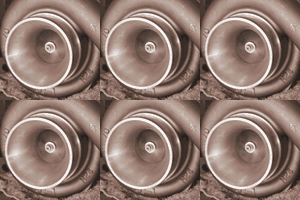
I know what you mean. I am still not really comfortable with Fuel injection myself. I am really not looking ot take major parts off. I am trying to stay with quick, bolt-on type changes. I have quite a few projects already in the works this one is a daily driver and can't be down more than an hour or so really.....I can always tune a carb or rebuild it, but fuel injection leaves me baffled. This is the engine in my Formula....just so you can see where I am coming from:

#24
07-27-2006, 01:51 PM
that's a seriously purdy motor.
Just think about the functions of the old motors and try and figure out what sensors and doodads equal that in FI. After a while you'll get used to it.
Just think about the functions of the old motors and try and figure out what sensors and doodads equal that in FI. After a while you'll get used to it.

#27
07-28-2006, 08:29 AM
For a streetable car I would go with r3d on this. I have a quick change rear in my formula and have gear sets from 3:08's to 4:56's. With the 4:56's I can eat people in the 1/4 but gets crappy gas mileage and can't drive on the highway.

#29
06-30-2007, 12:14 PM
Common sense backed up with science
The idea is just to look at known, common sense solutions and add just a tiny bit of science to the mix.
The target audience is NOT a professional racer with 30 years experience - but the beginner or non-mechanical owner bewildered by all the choices and advice out there. The common sense concept has for a long time been that most Mustangs benefit from lower gears - and with the simple math equation, this is supported and can be weiged against the many competing options.
Almost everyone will come to a decision fork where they scratch their head, look at the condition of their wallet, and try to figure out what comes next...
Plug the options into the math, and see what comes out the bottom. Lots of times, it will NOT be the first thing that you considered.
The target audience is NOT a professional racer with 30 years experience - but the beginner or non-mechanical owner bewildered by all the choices and advice out there. The common sense concept has for a long time been that most Mustangs benefit from lower gears - and with the simple math equation, this is supported and can be weiged against the many competing options.
Almost everyone will come to a decision fork where they scratch their head, look at the condition of their wallet, and try to figure out what comes next...
Plug the options into the math, and see what comes out the bottom. Lots of times, it will NOT be the first thing that you considered.
#30
07-06-2007, 02:04 PM
 what should come first
I am pretty new to this performance thing. I have a 01 GT Auto with CAI, under pullies, 75mm TB and Plenum, and Flowmaster 40 catback. I don't know what to go with next, a tune to get everything working together or throw in 3.73s or what. If there is any advise out there please let me know.